Introduction
Epoxy flooring is widely used in commercial, industrial, and residential spaces because of its durability, smooth finish, and resistance to wear. However, the quality of an epoxy floor depends not only on the coating material but also on how well the underlying surface is prepared before application.
Proper surface preparation helps epoxy bond effectively with concrete, reduces the risk of coating failure, and improves the overall appearance of the finished floor. Skipping this essential step can lead to peeling, bubbling, uneven finishes, and premature damage.
For businesses and property owners planning durable flooring solutions, understanding coating preparation is an important part of achieving reliable results.
Explore professional epoxy flooring services:
https://www.singcons.com/epoxy.php
What Is Surface Preparation in Epoxy Flooring?
Surface preparation is the process of cleaning, repairing, and conditioning a floor before applying an epoxy coating. The objective is to create a clean, sound, and suitably textured surface that allows the coating to adhere properly.
Concrete surfaces may contain dust, oil, grease, moisture, old coatings, curing compounds, or loose material. These contaminants can interfere with epoxy bonding and reduce the performance of the finished floor.
Depending on the condition of the concrete and the epoxy system being used, preparation may involve mechanical grinding, shot blasting, crack repair, degreasing, and moisture testing.
Why Surface Preparation Matters Before Applying Epoxy
1. Improves Epoxy Adhesion
Strong adhesion is essential for a durable epoxy floor. When concrete is contaminated with dust, grease, or loose particles, the coating may not bond properly to the substrate.
Mechanical preparation helps remove weak surface material and creates an appropriate profile for the epoxy system. This allows the coating to form a stronger bond with the concrete.
2. Prevents Peeling and Delamination
Poor adhesion can cause epoxy coatings to separate from the concrete. This problem may appear as peeling, flaking, or large sections of detached coating.
Proper cleaning, surface profiling, and substrate inspection help reduce the likelihood of delamination and improve the reliability of the flooring system.
3. Reduces Bubbling and Blistering
Air, trapped contaminants, moisture, and vapor movement through concrete can contribute to bubbles or blisters in epoxy coatings.
Before application, contractors should assess moisture conditions, remove contaminants, and follow the epoxy manufacturer's recommendations for substrate preparation and environmental conditions.
Correct preparation helps reduce defects and supports a more consistent finish.
4. Creates a Smooth and Professional Finish
Uneven concrete, cracks, holes, and surface imperfections can affect the final appearance of epoxy flooring.
Repairing damaged areas and preparing the surface evenly helps produce a cleaner, more uniform finish. The required level of smoothness depends on the selected coating system and the intended use of the floor.
5. Extends Floor Service Life
Epoxy flooring installed over a properly prepared surface is better positioned to withstand normal traffic, abrasion, and operational demands.
Although preparation cannot eliminate every cause of coating failure, it helps reduce avoidable adhesion problems and supports long-term flooring performance.
6. Improves Resistance to Everyday Wear
Industrial and commercial floors may experience foot traffic, equipment movement, spills, and repeated cleaning.
A correctly prepared substrate helps the epoxy coating perform as intended under these conditions. The overall durability also depends on coating thickness, product selection, installation quality, and maintenance practices.
Essential Steps in Epoxy Surface Preparation
1. Inspect the Concrete Surface
The preparation process begins with a detailed inspection of the existing floor.
Contractors should identify cracks, damaged areas, previous coatings, contamination, weak concrete, and signs of moisture. This assessment helps determine the appropriate preparation method.
2. Remove Dirt, Oil, and Grease
The floor must be free from contaminants that could interfere with bonding.
Suitable cleaning products and degreasing methods should be selected according to the type of contamination and the requirements of the coating system. The surface should be thoroughly cleaned and allowed to reach the required condition before further preparation.
3. Use Mechanical Surface Preparation
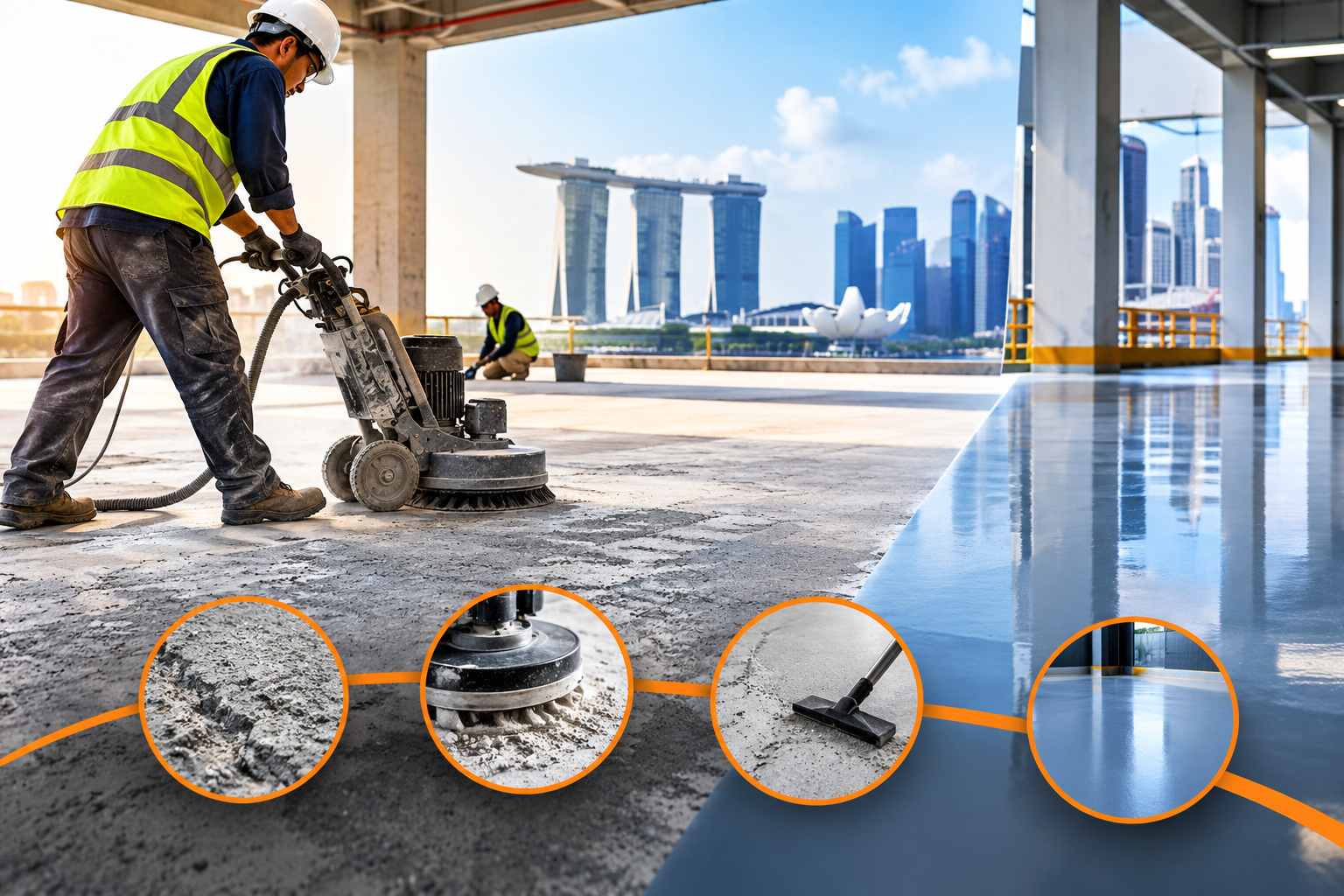
Mechanical methods such as diamond grinding and shot blasting are commonly used to remove weak surface layers and create the appropriate concrete profile.
The correct method depends on the existing floor condition, the coating specifications, and the required surface texture. Acid etching should not be treated as a universal substitute for mechanical preparation, particularly where the selected epoxy system specifies mechanical profiling.
4. Repair Cracks and Surface Defects
Cracks, holes, spalled concrete, and damaged joints should be assessed before coating application.
Suitable repair materials can be used to address defects according to their type and movement characteristics. Active cracks and structural issues may require additional investigation rather than simple surface filling.
5. Remove Dust Thoroughly
Grinding and other mechanical processes can leave fine dust on the floor.
Industrial vacuum equipment is commonly used to remove dust and loose particles. A clean surface helps prevent contaminants from becoming trapped between the concrete and the epoxy coating.
6. Check Moisture Conditions
Moisture is an important consideration because excessive moisture or vapor transmission can interfere with certain epoxy systems.
Contractors should perform appropriate moisture testing and compare the results with the coating manufacturer's requirements. Moisture mitigation may be necessary where conditions exceed the product's specified limits.
7. Confirm Surface Readiness
Before applying epoxy, the contractor should verify that the surface meets the requirements for cleanliness, dryness or moisture limits, surface profile, and structural soundness.
Temperature, humidity, and concrete conditions should also be checked according to the product instructions.
Completing these checks helps reduce installation problems and supports consistent coating performance.
Choosing the Right Surface Preparation Method
Different floors require different preparation techniques.
Diamond grinding: Suitable for many projects requiring removal of surface contaminants, coatings, or weak concrete and the creation of a controlled profile.
Shot blasting: Often used on larger concrete floors where a consistent mechanical profile is required.
Crack and joint repair: Addresses defects that could affect the coating's appearance or performance, using repair methods appropriate to the condition.
Specialized cleaning: Helps remove oils, grease, and other contaminants before mechanical preparation or coating.
The correct approach should be selected after inspecting the concrete and reviewing the requirements of the specified epoxy product.
Benefits of Professional Epoxy Flooring Installation
Professional installation helps ensure that each stage of the flooring process is completed according to the project's requirements.
Experienced contractors can assess the substrate, select appropriate preparation equipment, identify potential moisture problems, and apply the coating under suitable conditions.
Professional epoxy flooring services may be particularly valuable in warehouses, factories, garages, commercial facilities, and other environments where floor durability and operational reliability are important.
Learn more about epoxy flooring solutions:
https://www.singcons.com/epoxy.php
Frequently Asked Questions
1. Why is surface preparation necessary before applying epoxy flooring?
Surface preparation removes contaminants, eliminates weak material, repairs defects, and creates a suitable profile for bonding. It helps reduce peeling, blistering, and other coating problems.
2. Can epoxy be applied directly over existing concrete?
Epoxy can be applied over suitable concrete, but the surface must first be inspected and prepared according to the coating manufacturer's specifications. Cleaning, mechanical profiling, repairs, and moisture testing may be required.
3. What happens if concrete is not prepared properly?
Inadequate preparation can lead to poor adhesion, peeling, bubbles, uneven finishes, and premature coating failure. It may also increase repair and maintenance costs.
4. How do contractors prepare concrete for epoxy coatings?
Preparation commonly includes inspecting the floor, removing contaminants, grinding or shot blasting, repairing defects, vacuuming dust, checking moisture conditions, and confirming surface readiness before application.
5. Does moisture affect epoxy flooring?
Yes. Excessive moisture or vapor transmission can cause adhesion problems and coating defects in systems that are not designed for those conditions. Appropriate testing and product selection are essential.
Conclusion
Surface preparation is one of the most important stages of epoxy flooring installation. Cleaning, mechanical profiling, crack repair, dust removal, and moisture assessment help create suitable conditions for strong adhesion and a consistent finish.
Skipping these steps can increase the risk of peeling, bubbling, and premature deterioration, even when high-quality epoxy materials are used. By selecting the right preparation methods and following the coating manufacturer's recommendations, property owners can improve flooring reliability and reduce avoidable maintenance issues.
For professional epoxy flooring solutions, explore Singcons.
Visit Website: https://www.singcons.com/epoxy.php